
Trump's Foreign Policy and Its Fragile Potential to Address Multipolarity
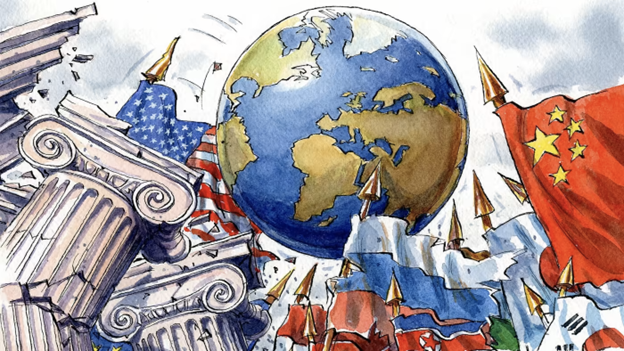
Image source: Ingram Pinn via the Financial Times
By: Nik Vacano
The international system is entering a period characterized by “multipolarity,” in which a large number of states hold meaningful sway over the conduct of trade, warfare, the functions of international organizations and can otherwise use their power to heavily influence events. The transition this implies from the “unipolar moment” after the Cold War, during which the US was the only superpower, means that any effort to preserve standardized commerce and clear limits on aggression must contend with the complex and varied concerns of this increasingly high number of influential states. In the following article, I argue that the US, if it is to remain a credible, hegemonic force on the new world stage, ought to, in a highly qualified way, adopt some of President Trump’s ideas about American retrenchment to pave the way for it to become a more hands-off, sponsorial hegemon, with unique powers attendant to that newfound role. This means America intervening directly in international affairs only in limited cases and leaving the maintenance of regional stability and the upholding of standards for interstate conduct primarily to lesser, allied powers, situating the US as a kingmaker of sorts, rather than a directly intervening power like a 19th century gunboat empire. Elaborating on this, I would like to start by setting the stage for how the multipolar realignment and Trump’s influence on the global stage have been written about previously and how I find they suggest a fascinating opening for something new.
At the beginning of the year, the renowned geopolitics scholar Ian Bremmer, alongside his think tank, the Eurasia Group, offered a set of what they consider to be 2025’s geopolitical “top risks.” Taking the premier spot as the greatest risk was “the G-zero wins.” Per Bremmer, the “G-zero” is a dark inversion of the G-7 and G-20 fora for global policy-setting. While those fora endeavor to coordinate trade policy and economic activity under the steady hand of a set of consistent rules upheld by the planet’s largest economies, the G-zero implies virtual anarchy. It is a condition under which no hegemon or coalition of significant states can exert power on the international system in such a way as to sufficiently offer a level of constant stability benefiting them and other states aligned with them. As such, a G-zero world is defined by, as Bremmer puts it, “the law of the jungle,” a pervasive absence of rules governing interstate behavior that endlessly reproduces insecurity and opportunities for predatory state activity.
There is a degree to which, per various analyses, the reality of a pervasive descent into a G-zero is actively creating room for interstate conflict and the collapse of various norms that maintain global peace. The Russian war in Ukraine, as well as concurrent conflicts, like Israel’s invasion of Gaza and the civil war in Sudan, demonstrate that the prohibition on wars of conquest and concerns for humanitarian standards have been heavily eroded by low interstate resolve to preserve them, as the International Crisis Group has documented. One needs only to look to West Africa or the Democratic Republic of the Congo to see how the current absence of pervasive global diplomatic or military leadership in certain corners of the world is creating opportunities for these very norms to be undermined, leading states to fight one another and/or fall victim to a whole slew of dangerous non-state actors.
The second most important risk Bremmer and his Eurasia group identified was the “rule of Don.” Per their reading of the situation, the US, following the highly transactional worldview of its new president, Donald Trump, might actively contribute to creating more global instability by threatening American trade relationships and seeking to predate on other states, even allies (like Canada and Denmark), either by threatening their territorial integrity or wielding military and economic power against them in order to extract certain concessions. This, they argue, has the potential to breed resentment, mistrust and reciprocal viciousness among those states America slights against. Bremmer and the Eurasia Group’s concerns have borne out, to some extent. Trump has, after all, actively threatened America’s economic relationships through his haphazard use of tariffs while also undermining the strategic coherence of power-multiplying alliances like NATO, creating vulnerabilities in the US-led order which revisionist authoritarian powers (like China and Russia) can exploit by exacerbating internal disputes or courting relatively neutral states to their camp.
However, in a subversive way, the quirks of Trump’s ideological outlook could produce an opening for a new American foreign policy consensus to take hold, one that is better suited to generating legitimate global governance in an increasingly multipolar world than the unipolar thinking of previous regimes. In this way, “the rule of Don” could, potentially, thwart the descent into a total G-zero status quo. To demonstrate what I mean, I’ll discuss the recent chaos in the Middle East and how it is illustrative of a wider approach of the Trump administration to foreign affairs that suggests some positive policy change conducive to multipolarity.
In the middle of June, as the ISW documented with daily reports, the Middle East was convulsed by Israel, then the US, launching aerial strikes on Iran intended to eliminate its nuclear enrichment capabilities. As of writing, an uneasy ceasefire is now in place between the three countries and Iran’s nuclear enrichment capabilities have been heavily degraded. It remains to be seen whether or not those strikes will prove a positive development for regional stability or a step towards creating an eventual, wider conflagration.
What these strikes, and the way they proceeded, demonstrate, however, is that the Trump administration’s objective of creating “peace through strength,” and of renegotiating American hegemony more broadly, must seriously contend with the breakdown of the unipolar system if it is to be successful. Otherwise, relying on logic inherited from periods of US unipolarity and seeking to impose the country’s will unilaterally on specific states or regions could lead to potentially severe miscalculations. After all, Israel played a substantial role in gathering intelligence on Iranian nuclear capabilities and then used the Mossad’s human terrain networks and its own arsenal to soften up the Iranian air force and their on-the-ground anti-air capabilities, creating room for America to engage in the bombardments that more or less ended the main phase of the conflict. This helped feed into the relatively quick resolution of the state of war between America, Iran and Israel and paved the way for a new Middle Eastern power dynamic, with a less heavily armed and less bold Iranian-led Axis of Resistance, to take hold. Had the US tried to attack Iran alone, any improper reservations on its part, reliance on faulty intelligence or anything similar might only have produced an extended conflict by creating a less decisive, immediate outcome.
Given all of this, it becomes clear that, in a multipolar world, the importance of actors like Israel in maintaining security in particular areas has made the US less indispensable to the maintenance of international stability. Therefore, a shift away from a directly interventionist approach towards a more “sponsorial hegemony,” where the US actively works to shift the onus for generating deterrence onto allied lesser powers and potentially also balances them against one another to create a rough form of deterrence and accountability between each, becomes necessary. In the context of the Middle East, this could mean awarding further economic opportunities and military contracts to the Gulf States, similar to a recent agreement Trump has already initiated with Saudi Arabia, as a long-term counterbalance to Israel. In turn, this could lead to the empowering of credible actors capable of preventing a full descent into a G-zero and situates the United States, with its outsized economic prominence and existing military capabilities, as a powerful kingmaker.
All over the world, regionally powerful states have both the capabilities and the will to meet their local challenges in a comprehensive way, addressing them more thoroughly than a far-removed hegemon might because of their higher proximity to whatever challenge they are trying to address. Therefore, the US unilaterally seeking to impose its will on these regions seems a paltry solution in comparison to what it might do by collaborating with these powers. This implies that US interests would be far better served, in a time of rising multipolarity, by limiting itself to clear contributions where they appear really necessary.
In many ways, a more hands-off approach in line with this new “sponsorial hegemony” jives very well with elements of Trump’s geopolitical code. After all, it allows the United States to pull back from its leading role in various areas by giving power to subordinates. However, Trump might only integrate it into his foreign policy via unconsolidated half-measures, given his erratic tendencies. His recent situating of US naval forces in such a way as to begin a full-on intervention into Venezuela, as well as his aforementioned tendency towards unproductive disruptions, makes the opportunity for sponsorial hegemony to take hold seem meaningfully up-to-dispute. As such, he would be well-advised to not dismiss this singular opportunity, instead pursuing a course that enables the United States to deal with uniquely 21st century challenges by depending on its allies and reserving, for itself, a basically mediating and stabilizing role in global affairs. Such an approach would redeem some of the destabilization he has already caused and the confusion over US commitments he has inspired, paving the way for positive, enduring change.