
The Taiwan Contingency: or Why the US Policy of Strategic Ambiguity is Dangerously Shortsighted
By Raleigh Smith
A 2022 People’s Republic of China (PRC) White Paper begins: “Resolving the Taiwan question and realizing China’s complete reunification…is indispensable for the realization of China’s rejuvenation.” The PRC is adamantly determined to (re)unite “both sides of the Taiwan Straits”.
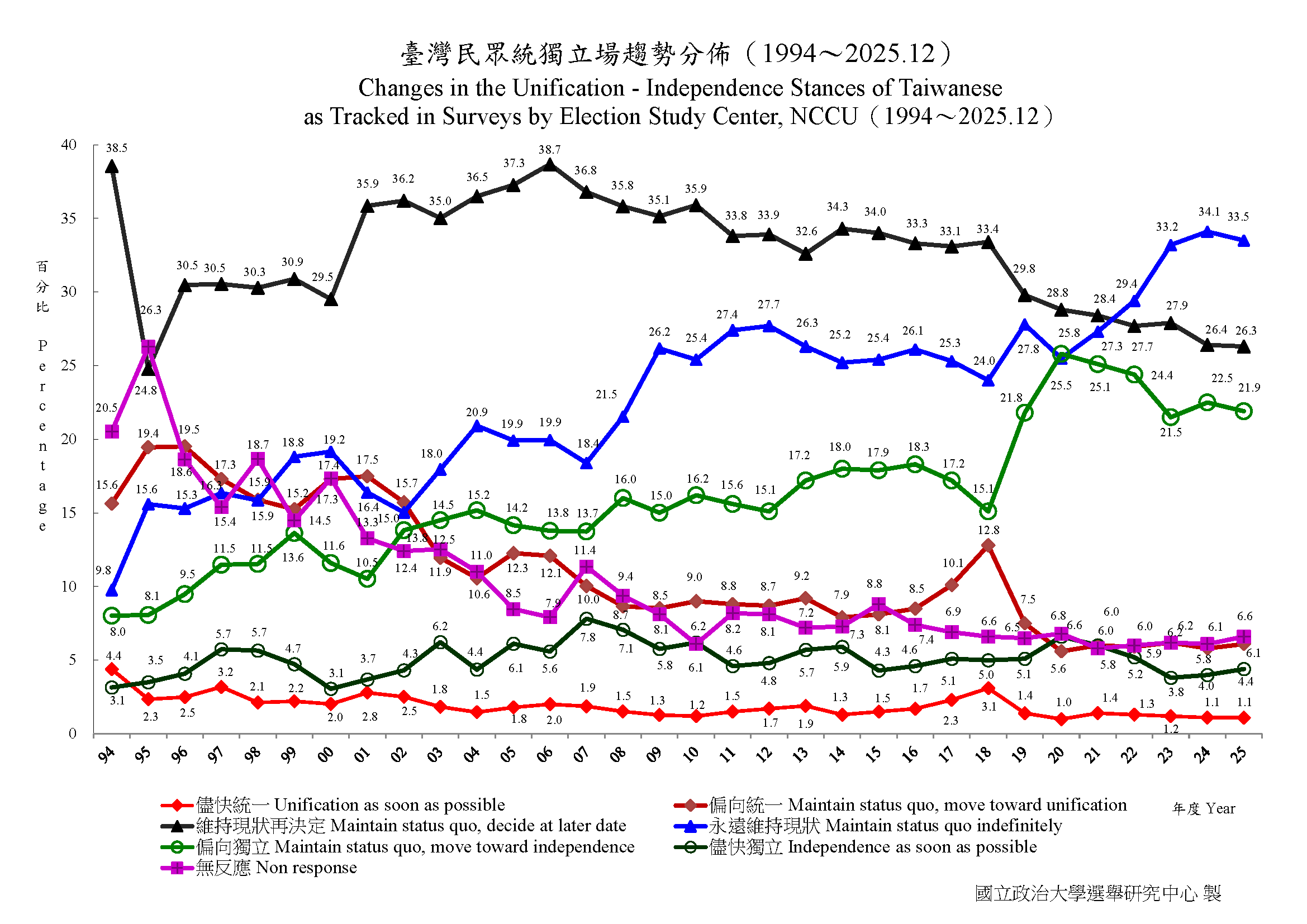
On the other hand, both the government and the people of Taiwan overwhelmingly oppose (re)unification anytime soon. Since 1999, Taiwan’s Democratic People’s Party (DPP) has maintained that Taiwan “is already an independent sovereign state”. As for Taiwanese citizens, a 2025 survey (presented above) revealed that “only 6.4% favored unification with mainland China”.
This is the central contradiction of the Taiwan Contingency, and its inevitable resolution threatens to embroil the world in a great power war.
The Historical Origins of the Status Quo
As it currently stands, Taiwan enjoys de facto sovereignty, without official international recognition. Even though the Republic of China (ROC) maintains official relations with only 11 UN member states, its Executive Yuan states that the unofficial count is significantly higher, most significantly including the United States and the European Union.
Like many geopolitical hornet nests, this status quo has its origins in World War Two.
After the second Sino-Japanese war was subsumed into the second World War, the Republic of China (ROC) and the Allied Forces signed the Cairo Declaration (1943), which mandated that “all the territories Japan has stolen from the Chinese… shall be restored to the Republic of China.”
However, by 1949, the Chinese Communist Party (CCP) had declared victory in the civil war and established the People’s Republic of China (PRC). Subsequently, the ROC “fled to Taiwan and maintained… a rival Chinese government”. As the PRC prepared to cross the strait and finish the war, President Harry Truman ordered “the U.S. Seventh Fleet to patrol the Taiwan Strait”. Using the pretext of the Korean War, the US was able defend the ROC without directly antagonizing the PRC.
Following this order, the Chinese Civil War entered its current stalemate. In 1952, when the Treaty of San Francisco formally concluded the War in the Pacific, Japan “renounced all right, title, and claim to Formosa [Taiwan]” without officially transferring it to any specific country. While the 1971 UN Resolution 2758 officially recognized the PRC as the “only legitimate representative of China”, no territory changed hands.
Strategic Ambiguity and Triangular Deterrence
Two contradictory US statements from the 1970s best exemplify the long-term policy of strategic ambiguity: the 1972 Shanghai Communique and the 1979 Taiwan Relations Act.
In 1972, President Nixon and Chairman Mao normalized relations between their two countries. Mao argued that the “crucial question obstructing the normalization of relations” was the status of Taiwan. Nixon conceded that “all Chinese on either side of the Taiwan Strait maintain that there is but one China and that Taiwan is a part of China.”
On the other hand, the 1979 Taiwan Relations Act (TRA) reestablishes the US’s desire to prevent a PRC occupation of Taiwan. While the TRA stops short of “commit[ting] to a specific action in response to a PRC action on Taiwan” it makes clear that the US will consider “any effort to determine the future of Taiwan by other than peaceful means… of grave concern to the United States”.
The maintenance of this ambiguous status quo relies on a less ambiguous strategy of triangular deterrence. For the past 40 years, “Taiwan [has been] deterred from declaring formal independence, the United States [has been] deterred from recognizing Taiwan as an independent state… and the PRC [has been] deterred from using military force against Taiwan to compel unification.”
However, as the PRC edges closer to unseating the USA as the global hegemon, the robustness of this deterrence is being questioned.
Hurtling Towards a Resolution
As shown in the 2025 NCCU survey above, the largest plurality of Taiwanese desired to “maintain [the] status quo indefinitely”. Further an astronomical 87% of Taiwanese prefer to maintain the status quo in some form, with only 6% wanting to move toward reunification. By all accounts, the USA shares this sentiment.
The PRC certainly does not.
In 1981, Deng Xiaoping “posed the ‘One Country, Two Systems’ (1C2S) framework as a viable way for peaceful unification.” A decade later, the ROC and PRC met in Hong Kong and “produced the 1992 Consensus, in which both sides agreed there was one China, but each might maintain a separate interpretation of its meaning.” All well within the bounds of ambiguity.
However, in 2005, the PRC passed the Anti-Secession Law, which affirmed that if the PRC determines “that possibilities for a peaceful reunification should be completely exhausted, the state shall employ non-peaceful means and other necessary measures to protect China's sovereignty and territorial integrity.”
While the language about “no interference by any outside forces” is a clear statement to the USA, the language of “Taiwan compatriots” and “compatriots on both sides of the Taiwan Straits” obscures the pointed attack toward the Taiwanese government. Despite insisting that the PRC is fully committed to peaceful reunification, the threats to “the ‘Taiwan independence’ secessionist forces” is clearly meant for the DPP, as well as the 62% of Taiwanese citizens who view themselves as only Taiwanese.
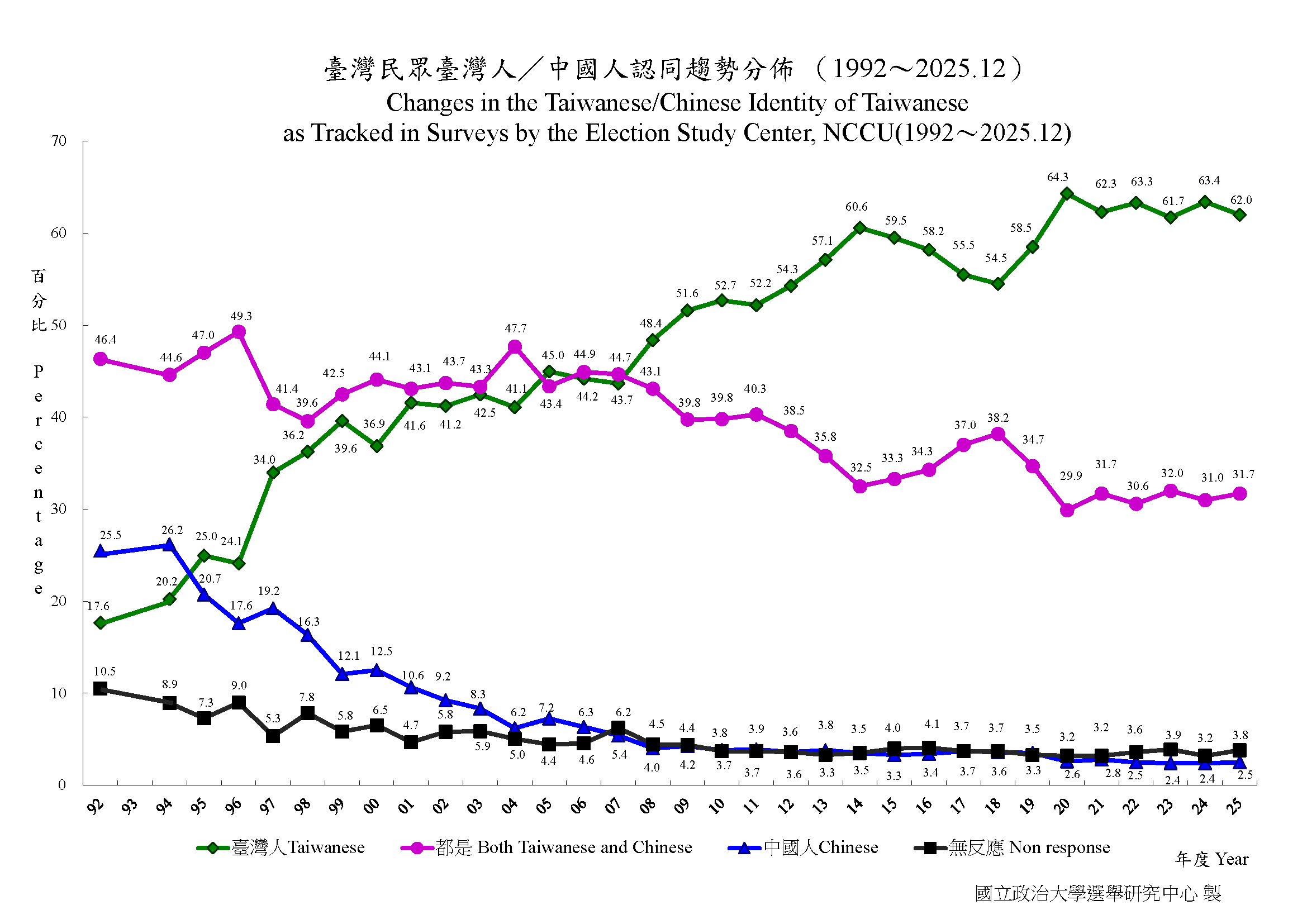
The demographic trends presented in the above 2026 NCCU survey detail the changing identity of Taiwanese citizens. While in 1992, 75% of respondents identified as at least partly Chinese, by 2025 that number had declined to less than 35%. Respondents identifying as only Chinese declined from 25% to 2%.
This is a ticking timebomb for the status quo. This demographic shift ensures that eventually, even the parties receptive to reunification, such as the Kuomintang, will be forced to court the ‘Taiwanese-only’ voters and thus modify their stance on reunification. More broadly, it means expansion of the PRC-branded secessionists at the expense of the Taiwanese compatriots.
In other words, possibilities for peaceful reunification are rapidly becoming exhausted.
Dangerous Ambiguity and Values of Self-Determination
Strategic ambiguity has undoubtedly been successful. The clearest evidence is the very demographic shift which has destroyed its strategic efficacy. The PRC was deterred for long enough that the people of Taiwan identify themselves as separate from the people of the Chinese mainland.
Simultaneously, the PRC has grown both in military power and in fear of a formal Taiwanese secession. Eventually, the day will come when the PRC is willing to call the bluff of the USA’s ambiguity. If the bluff is not a bluff, then the world will have sleep-walked into a great power war.
The question posed by a seemingly eminent USA-PRC power transition centers on how the ‘rules of the game’ will change under a PRC hegemon. Taiwan is the proverbial canary in the coal mine.
The post-war peace and the subsequent liberal order are based around the principle of self-determination. The people of Taiwan have determined that they are independent from not only the government in Beijing, but also the people of mainland China.
As the USA faces the twilight of its hegemony, it has an opportunity and a responsibility to prevent the mistakes of the 20th century. Power transitions are always dangerous; nuclear weapons make this one existential. Ambiguity in the face of this threat is not strategic, it’s dangerous.